Documentation Index

Fetch the complete documentation index at: https://docs.retellai.com/llms.txt

Use this file to discover all available pages before exploring further.

Versioning lets you update an agent while keeping other versions unchanged for production use. It has two main purposes:
  1. Lock in configuration: published versions cannot be changed, and you can attach specific versions to phone numbers or environment tags to lock in the agent configuration.
  2. Version control & history: you can create multiple draft versions from any past version, track your version history, and publish any draft when it’s ready.

How version numbers work

Version numbers start at V0 and go up by one each time you create a new version. The dashboard labels tell you whether a version is live or still in progress.
UIMeaning
V0, V1, V2, …Published versions, immutable
V3 (draft), V4 (draft), …Draft versions — unpublished copies that reserve the next version number. The (draft) suffix means you can still edit and publish them.
Example flow
  1. You publish your first agent → V0 appears under Published.
  2. You create a new draft from V0 → the UI shows V1 (draft) under Draft.
  3. You publish that draft → V1 moves to Published and is no longer editable.
  4. You create another draft from V1 → V2 (draft) appears under Draft.
Multiple drafts can exist at the same time (for example V2 (draft) and V3 (draft)). Each version also shows which version it was branched from.
Published versions cannot be changed. Only versions labeled with (draft) can be edited.

How to manage versions

Click the version button in the upper right corner of the agent page to open the versions panel.
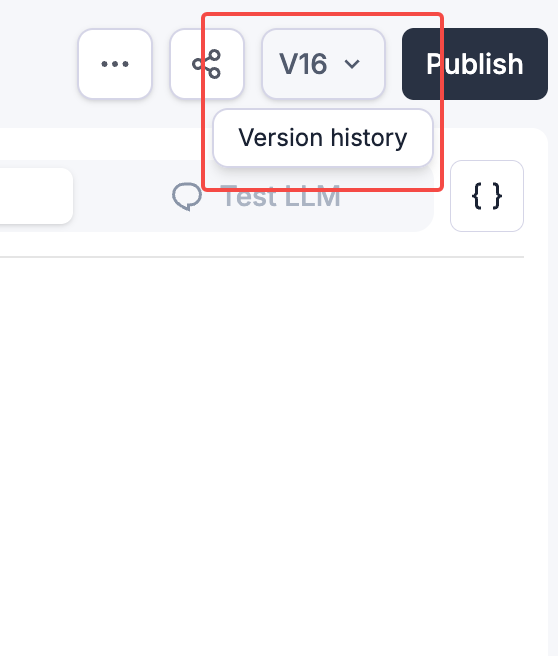
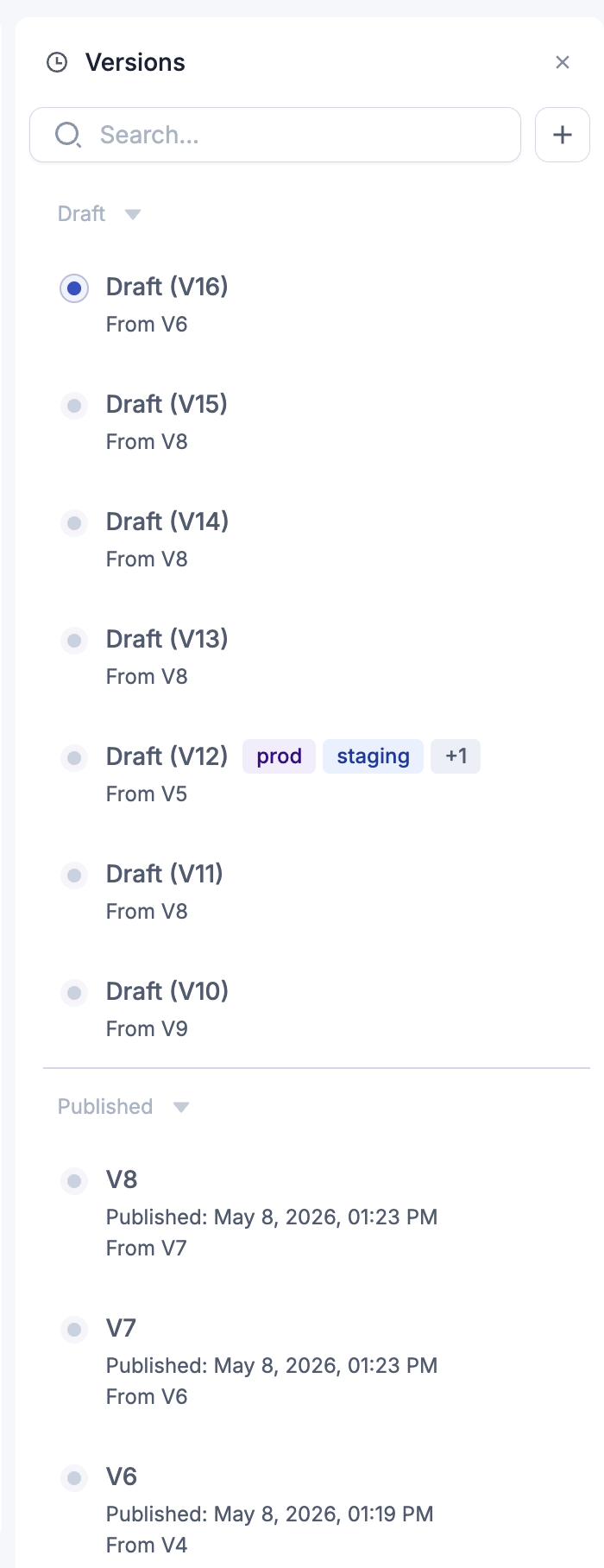
The panel shows two sections:
  • Draft: unpublished versions that can still be edited.
  • Published
Versions with attached environment tags (e.g. prod, staging) are shown inline on the version entry.

Create a new draft

Click the + button in the versions panel to create a new draft from the currently selected version. The draft will show which version it was branched from.

Publish a draft

You can publish any draft version. Select the draft in the versions panel, then click the Publish button in the upper right corner.
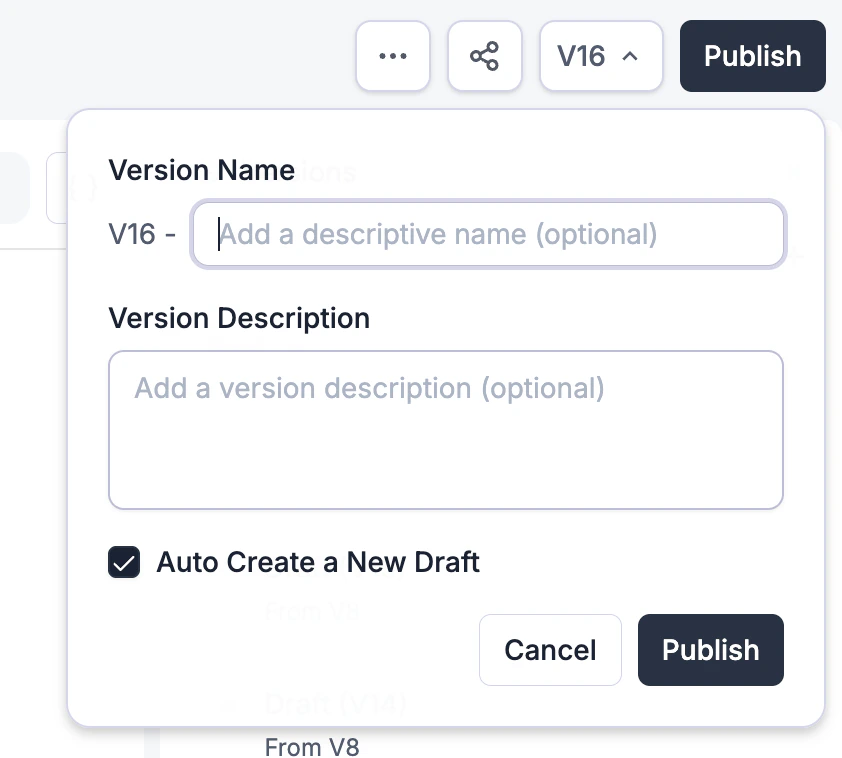
After clicking Publish, a modal appears where you can add an optional version name and description. You can also check Auto Create a New Draft to automatically create a new draft version after publishing.
To attach phone numbers to a version, use the Phone Numbers tab in the dashboard.

Delete a version

To delete a draft or published version, open the versions panel, select the version, and use the delete option. Published versions with active phone numbers or environment tags attached should have those removed before deleting.

Environment Tags

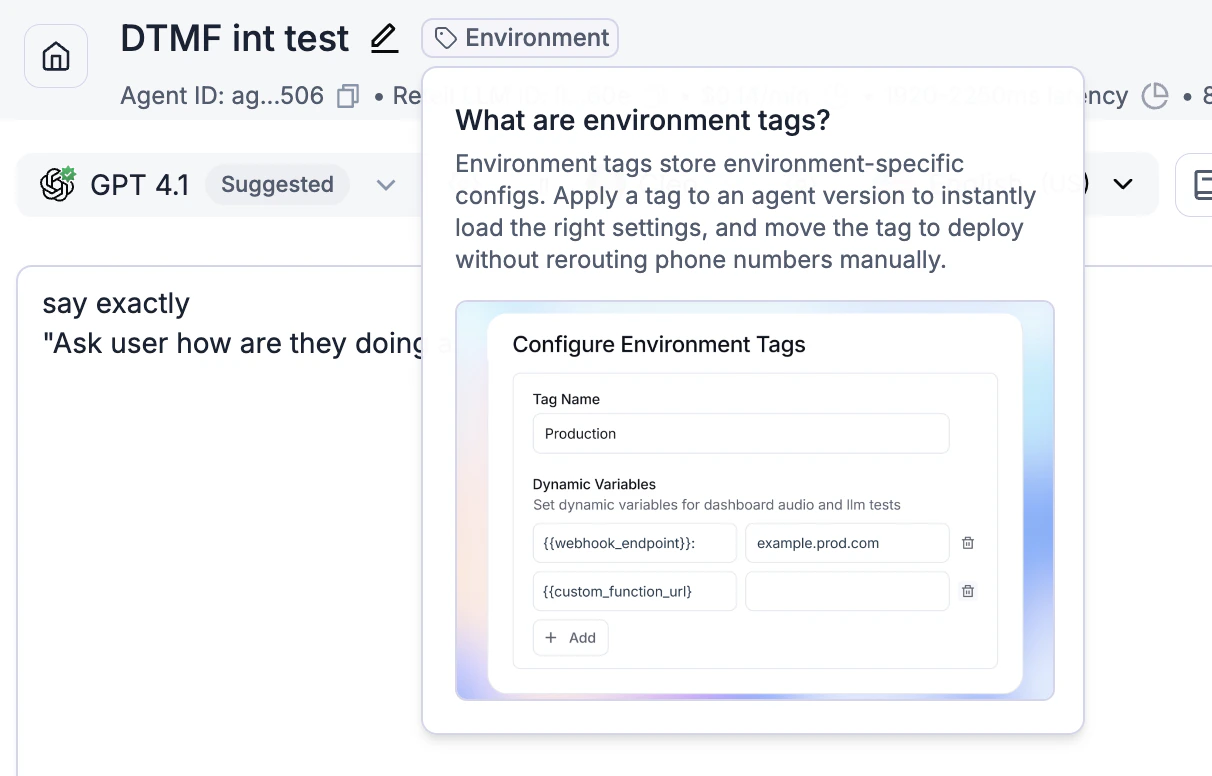
Environment tags store environment-specific configs. Apply a tag (e.g. prod, staging) to a version to instantly load the right settings — and move the tag to a different version to deploy without manually rerouting phone numbers, dynamic variables, etc. A version can have multiple tags attached.

How environment tags work

Each agent comes with prod and staging tags by default. You can create up to 10 tags total per agent (including the defaults). Tags serve two purposes:
  1. Labels — tags appear directly on version entries in the panel, so you can see at a glance which versions are running in which environments (e.g. which version is prod, which is staging).
  2. Environment-specific config — each tag carries its own set of dynamic variable values. When a tag is active on a version, those values are automatically injected, so the same agent behaves correctly across environments without duplicating configuration.
To deploy a new version, move the tag from the old version to the new one. Phone numbers, webhooks, and anything else pointing to that tag switch over instantly — no manual rerouting needed.

Configure tags

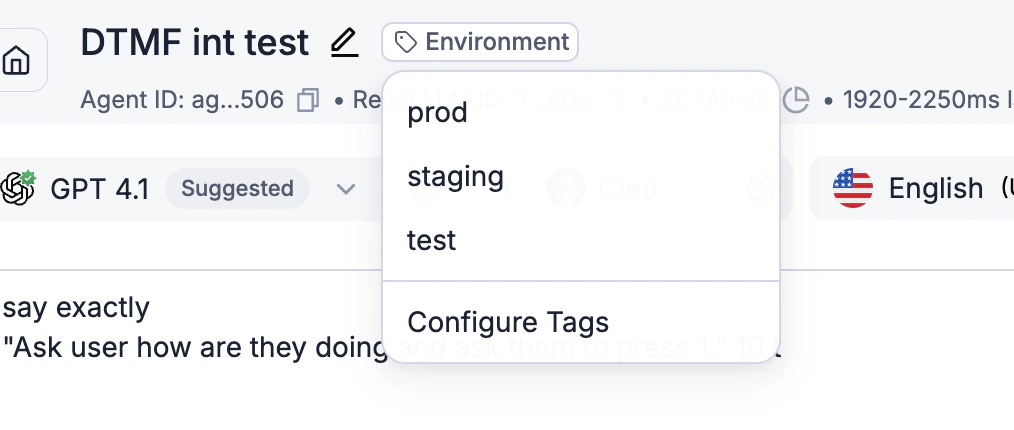
Click the Environment button in the agent header to apply a tag to the current version, or select Configure Tags to manage your tags.
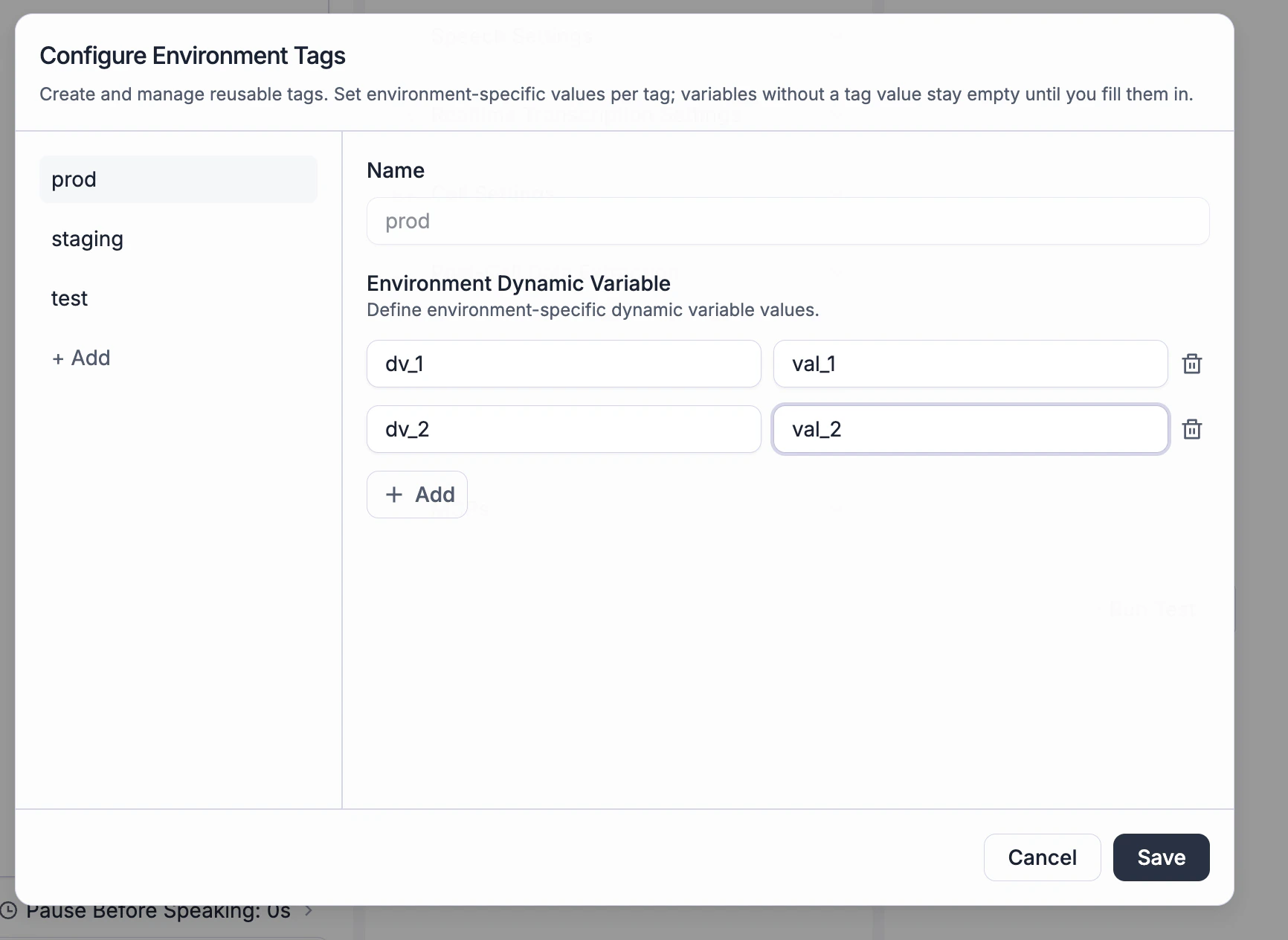
In the Configure Environment Tags modal you can:
  • Create a new tag by clicking + Add in the left sidebar and giving it a name.
  • Define environment dynamic variables — key/value pairs that are injected into the agent when that tag is active. This lets the same agent behave differently across environments without duplicating configuration.
Tag name requirements
  • Up to 20 characters
  • May contain lowercase letters, numbers, -, or _
  • Must start with a lowercase letter
  • Cannot be latest
  • Cannot match the pattern v followed by numbers only (e.g. v3, v12)

Applying tags to a version

To attach a tag to a version, select the version in the versions panel, then click the Environment button and choose the tag. The tag label will appear on the version entry in the panel.

How to use versions and tags in the API

You can pass a version reference in API calls such as get_agent, get_retell_llm, create_web_call, and create_phone_number. A version reference can be:
  • A version number, such as 2
  • latest
  • An environment tag, such as prod or staging
When you pass an environment tag, Retell uses the version currently assigned to that tag and applies the tag’s dynamic variables. If the tag exists but is not assigned to a version, Retell uses the latest version. If you do not pass a version reference, the Retell SDK defaults to the latest version of the agent.
// Gets the version with version number 2.
const agent = await client.agent.retrieve("agent_id", { version: 2 });

// Gets the version assigned to the prod tag.
const prodAgent = await client.agent.retrieve("agent_id", { version: "prod" });

// Starts a web call with the version assigned to the staging tag.
const webCall = await client.call.createWebCall({
  agent_id: "agent_id",
  agent_version: "staging",
});

// Gets the latest version of the agent.
const latestAgent = await client.agent.retrieve("agent_id");