

Retell has no built-in integrations with third-party chat platforms such as WhatsApp or Messenger. Beyond the website widget and SMS, you connect your own channel through the chat API.
When to use a chat agent
Use a chat agent when your users type instead of talk:- Website support — answer product, billing, or order questions in a chat widget on your site.
- SMS conversations — run two-way text threads on a Twilio number, such as appointment reminders with reschedule handling.
- In-app assistant — power a chat UI you build into your own web or mobile app.
Create a chat agent
1
Start a new agent
In the dashboard, open Agents, click Create an Agent, and select Chat Agent.
2
Pick an agent type
Choose Single prompt for simple free-form conversations or Conversational flow for production-ready, deterministic flows. Multi-Prompt (Legacy) is available under Other options. Custom LLM is voice-only, so it can’t power a chat agent.
3
Configure the agent
Write the prompt, attach functions and a knowledge base, and adjust the chat settings described below.
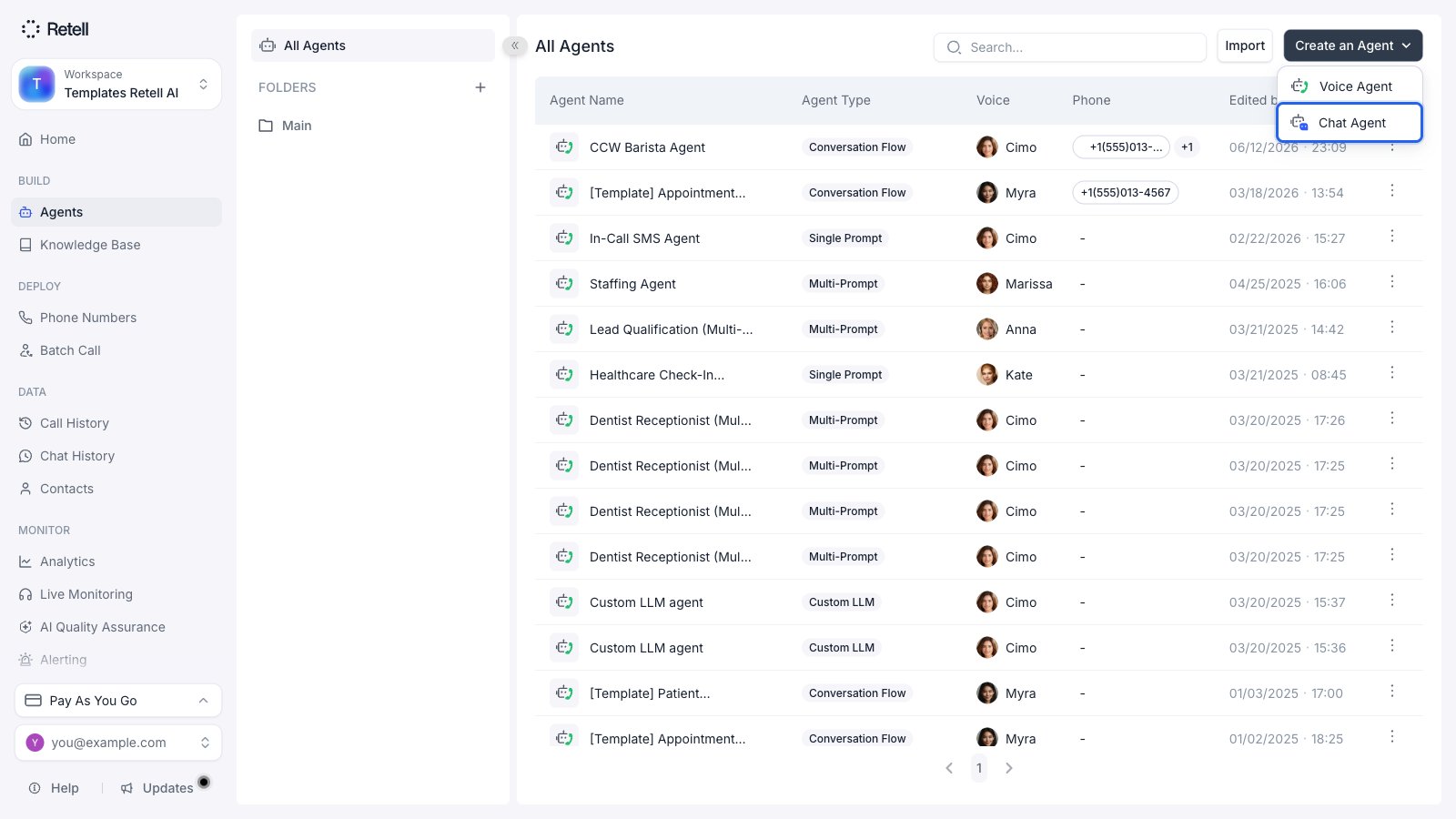
The Create an Agent menu on the Agents page, with the Chat Agent option highlighted.
Convert an existing voice agent
Converting creates a new chat agent based on your voice agent’s setup. The original voice agent is not modified and keeps working as before.1
Open the voice agent
In the agent builder, click the More options menu in the top-right corner and select Convert to Chat Agent.
2
Confirm the conversion
A dialog confirms that a new chat agent will be created and your original agent stays unchanged. Click Convert.
3
Review the new chat agent
Retell opens the new chat agent. Voice-only features are removed during conversion, so review the prompt and flow and adjust anything that referenced them.
- Nodes and functions: call transfer (including bridge and cancel transfer), press digit (IVR navigation), and mid-call SMS are deleted, and any dangling flow connections are cleaned up.
- Settings: voice, speech, transcription, and call settings (voicemail detection, DTMF input, and similar) don’t exist on chat agents.
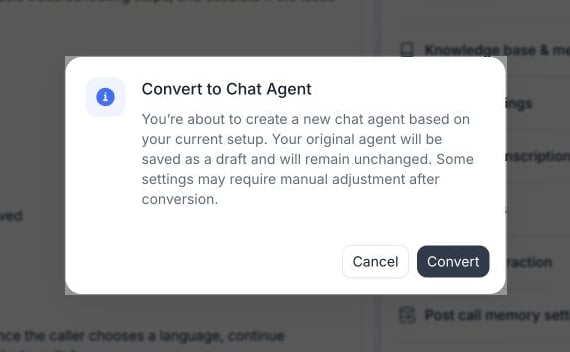
Review the conversion confirmation before creating a chat agent.
Chat settings
Chat agents share most configuration with voice agents — prompt, functions, knowledge base, webhooks, security, and Post chat extraction — and add a Chat settings section:- Auto-close inactive chats — end the chat automatically when the user stops responding. Set the timeout anywhere from 2 minutes to 72 hours (
end_chat_after_silence_ms; the API default is 1 hour). - Auto-close message — an optional message sent when a chat is closed automatically (
auto_close_message).
chat_started, chat_ended, and chat_analyzed by default; add transcript_updated through the agent’s webhook_events if you need per-message updates.
The agent’s Workflow page works the same as it does for voice, with the two function slots named pre-chat and post-chat functions: look the user up in your CRM before the agent’s first message, then log the outcome once the chat ends. See agent workflow.
Deploy your chat agent
Chat agents are headless — Retell does not host a chat UI for end users, so you choose how to surface the agent:- Website widget — embed a single
<script>tag on your site for text (and optional voice) chat with no backend required. See Retell Website Widget. - SMS — connect the agent to a Twilio phone number so users can text it directly. See Enable SMS.
- Custom integration — build your own UI on the chat API: Create chat starts a session, Create chat completion exchanges messages, and the session stays open until you call End chat or the inactivity timeout closes it.
FAQ
Can a chat agent use my custom LLM?
Can a chat agent use my custom LLM?
No. Chat agents support Retell LLM (single and multi prompt) and conversation flow response engines. Custom LLM agents are voice-only.
Does converting a voice agent change or delete the original?
Does converting a voice agent change or delete the original?
No. Conversion creates a separate chat agent; the original voice agent is untouched and any phone numbers attached to it keep working.
How does a chat session end?
How does a chat session end?
Three ways: the agent ends it (an end-chat node or function), you end it with the End chat API, or the user goes silent past the inactivity timeout and Retell closes it automatically.
How are chat agents billed?
How are chat agents billed?
Chat is billed per agent message, with add-ons (such as guardrails) also charged per message. See pricing for current rates.