

Bind voice agents
- A number can receive and make calls only after you bind an agent to it.
- You can assign different inbound and outbound agents to the number.
- Leave an agent unset to disable that direction. For example, if you only make outbound calls and don’t want callbacks, leave
inbound_agent_idunset.
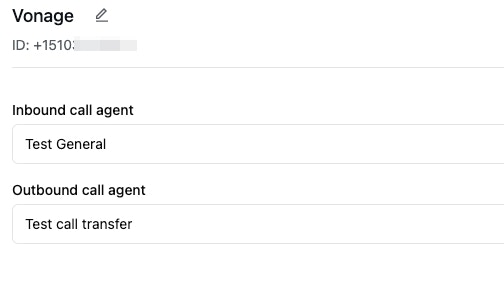
Bind inbound and outbound agents to your number
Handle inbound overflow
Inbound calls count toward your workspace concurrency limit. To keep inbound calls available during high outbound volume, you can reserve part of your concurrency for inbound calls. See Reserved Inbound Concurrency. If all concurrency slots are in use, Retell briefly waits for a slot to open. If no slot opens after about 40 seconds, Retell transfers the call to the phone number’sfallback_number when one is
configured. Without a fallback number, the call ends with concurrency_limit_reached.
A/B testing
See A/B Testing.Inbound call webhook
You may want to use different agents for inbound calls to the same number, or provide dynamic variables and other per-call fields. Read more at Inbound Call Webhook.Route calls to Retell’s SIP endpoint
If you’re routing inbound calls from your own carrier or PBX, point your SIP trunk or dial plan at Retell’s SIP server:- SIP server URI:
sip:sip.retellai.com - Transports: TCP (recommended), UDP, TLS, mTLS. Append
;transport=tcp,;transport=udp, or;transport=tlsto the URI to select one. - Media encryption: SRTP (requires TLS transport)
- Audio codecs: PCMU, PCMA, G.722 (HD)
- Re-INVITE support: Retell answers in-dialog re-INVITEs (media re-anchor, codec change, SRTP re-key, hold/unhold, offerless) — see the custom telephony FAQ
- IP blocks to whitelist:
18.98.16.120/30(signaling only),3.42.144.0/23,153.57.128.0/18,143.223.88.0/21(certain US traffic),161.115.160.0/19(certain US traffic)
Inbound custom SIP headers
- You can use custom SIP headers to pre-set dynamic variables for a call.
- Retell extracts any header starting with
sip.h.x-, along with common SIP headers likeDiversion,History-Info,User-To-UserandP-Asserted-Identity, and converts each into a dynamic variable by stripping thesip.h.prefix.- E.g.
sip.h.x-caller: abc->x-caller: abc - E.g.
sip.h.p-asserted-identity: +12345678910->p-asserted-identity: +12345678910 - E.g.
sip.h.diversion: <sip:2000@192.168.254.254>;privacy=off;reason=no-answer;counter=1;screen=no->diversion: <sip:2000@192.168.254.254>;privacy=off;reason=no-answer;counter=1;screen=no
- E.g.
Get call detail
- API: Use the Get Call API to get information like transcript, recording, and latency tracking.
- Webhook: Set up webhooks to receive real-time updates when a call is initiated, ends, and is analyzed. Read more at Call Webhook Guide.