

Event Types
Retell AI supports the following webhook events for voice calls:
Retell AI supports the following webhook events for chat:
Common Use Cases
-
Real-time Analytics
- Track call statistics and performance metrics
- Monitor call volumes and patterns
- Trigger alerts for specific call outcomes
-
System Integration
- Update CRM records when calls complete
- Trigger workflow automations based on call analysis
- Archive call transcripts in your data warehouse
-
Call Monitoring
- Get notified of failed or transferred calls
- Track call duration and completion status
- Monitor agent performance in real-time
Webhook Spec
The webhook willPOST the payload to your endpoint. The webhook has a timeout of 10 seconds. If within 10 seconds no success status (2xx) is received, the webhook will be retried, up to 3 times.
The webhook will be triggered in order, but is not blocking. For example, if the webhook for call_started is not successful, we can still trigger the call_ended webhook.
Your webhook endpoint must be publicly reachable. For security, Retell blocks requests to localhost, private IP ranges, and cloud metadata addresses, so expose a local endpoint with a tunneling service like ngrok before registering it.
dial_failed, dial_no_answer, dial_busy disconnection reason), it will not have its call_started webhook triggered. It will still have its call_ended and call_analyzed webhooks triggered.
Request payload
The webhook will contain the event type and the call object. See a sample payload in the “Handle Webhook” section below.Event filtering
You can limit which events are delivered per agent using thewebhook_events field when creating or updating an agent.
- Voice agent default:
call_started,call_ended,call_analyzed - Chat agent default:
chat_started,chat_ended,chat_analyzed
Register Webhook
We offer two types of webhooks: Agent-Level and Account-Level, designed to streamline your event notification process. Here’s a brief on each:Account-level webhooks
Set up through the dashboard’s webhooks tab, these webhooks notify you of events related to any agent under your account. Specify your webhook URL in the dashboard’s webhooks tab to activate.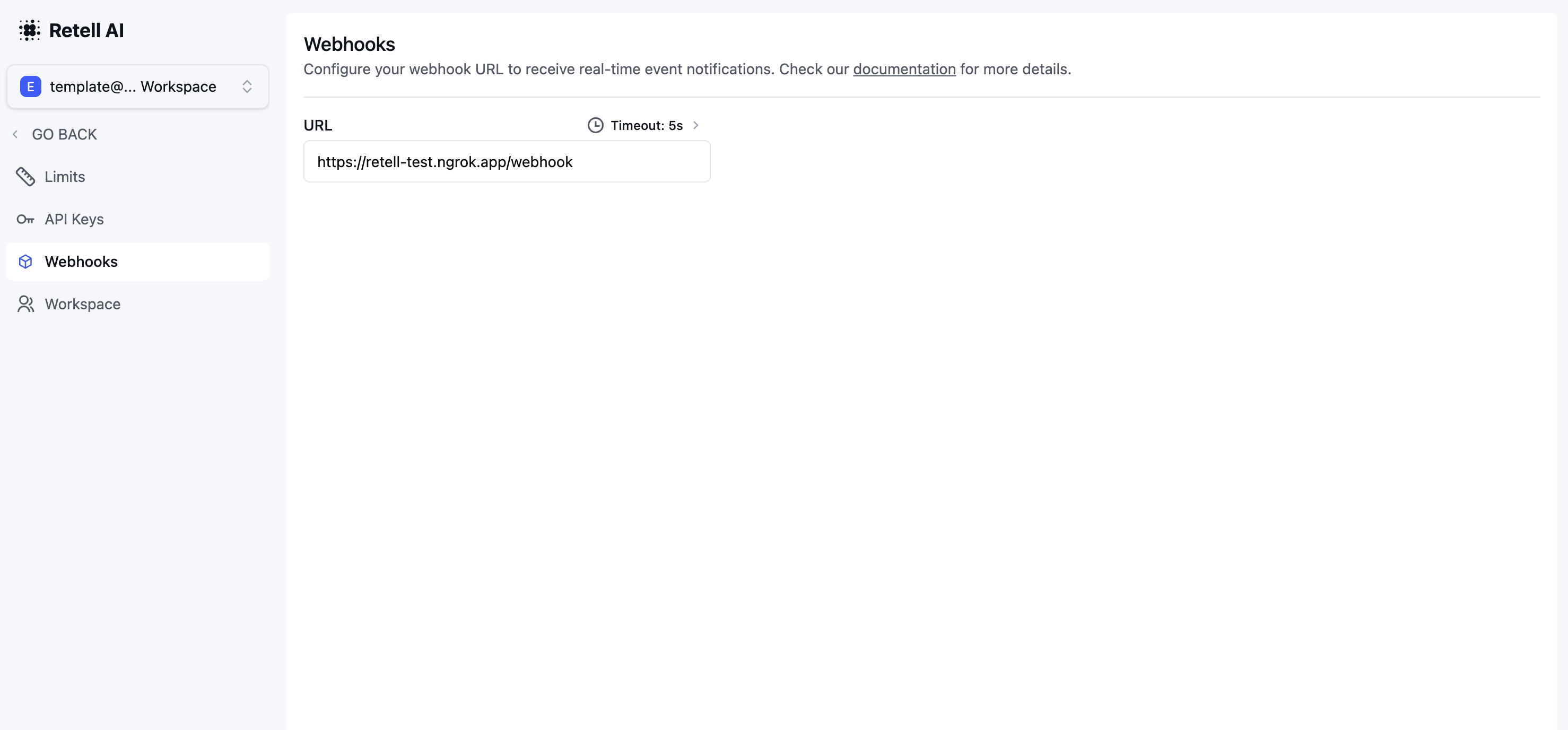
Agent-level webhooks
When you create the agent, you can set thewebhook_url field.
Any event associated with that agent will be pushed to the agent webhook URL. If set, the account-level webhook URL will not be triggered for that agent.
Webhook URLs support dynamic variables. For example, setting
webhook_url to https://example.com/webhook?customer={{customer_name}} resolves the {{customer_name}} placeholder per call before the event is delivered. This applies to both agent-level and account-level webhook URLs.Handle Webhook
After registering the webhook, you would want to verify the webhook is from Retell and handle it.Webhook Payload
The webhook will bePOST to the URL you provided with a JSON payload.
The payload will contain the event type and the call detail associated with the event.
It will contain an x-retell-signature header to help you verify the webhook comes from Retell.
Sample Payload
Thecall field in the webhook payload contains the call details. It’s the same content
you would receive when you fetch the call details using the get-call API.
transcript_updated events, the payload also includes transcript_with_tool_calls. For transfer events, the payload includes transfer_destination and (when available) transfer_option.
Sample Transfer event payload
Here is a compact example of a transfer webhook payload (fields may vary by transfer type):Verifying Webhook
You can use thex-retell-signature header together with your Retell API Key to verify the webhook.
We have provided
a verify function in our SDKs to help you with this.
You can also check and allowlist Retell IP addresses: 100.20.5.228.
The following code snippets demonstrate how to verify and handle the webhook in Node.js and Python.
For languages without an official SDK, see Verify Without SDK.
Sample Code
Testing Locally
To test webhooks on your local machine, you can use ngrok to generate a production URL forwarding requests to your local endpoints.Idempotency and deduplication
Retell retries each webhook up to 3 times if no2xx response is returned within 10 seconds, so your endpoint may receive the same event more than once. Make your consumer idempotent:
- Per-call lifecycle events (
call_started,call_ended,call_analyzed,chat_started,chat_ended,chat_analyzed): use the combination ofevent+call_id(orchat_id) as a unique key. These events fire at most once per call/chat, so storing the processed key in a database or cache and skipping repeats is sufficient. - Transfer events (
transfer_started,transfer_bridged,transfer_cancelled,transfer_ended): a single call may contain multiple transfer attempts. Useevent+call_id+start_timestamp(and, if needed,transfer_destination) so each transfer attempt is processed exactly once. transcript_updated: this event streams throughout the call and is expected to fire many times percall_id. Treat each delivery as an incremental update rather than deduplicating bycall_id— store the latest payload per call, or use the finaltranscript_updated(sent when the call ends) as the canonical transcript.
2xx status as soon as you have safely accepted the payload (e.g., persisted it to a queue). Doing heavy work before responding can trigger Retell’s 10-second retry and create duplicate processing.
Privacy
Choosing to “Opt-Out of Personal and Sensitive Data Storage” means transcripts and recordings post-call won’t be stored. However, transcripts and recordings remain accessible via webhooks, allowing for alternative storage solutions on your end. The recording will also be available in therecording_url field.
The link will be accessible for 10 minutes and will be
deleted and become inaccessible after 10 minutes.
Response
We expect a successful status code (2xx) to be returned. No body is expected.Video Tutorial
See community templates in docs.