

Global Node in the node settings to enable this.
Each global node adds a transition option across the conversation flow, increasing the number of choices the node transition model must distinguish. Use them sparingly for situations that need to be handled regardless of the current node. For example, if a conversation can go poorly at any point, a global catch-all node can handle that situation by transferring the caller to a human or ending the call. See limiting transition choices.
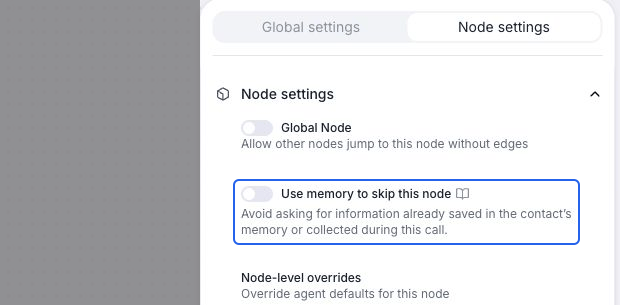
Global Node and memory skipping are configured in Node settings.
Configure Global Node
Set a condition for when the global node should be transitioned to. In the example above, the condition isWhen user indicates this is not a good time to continue — so whenever the user says something like I need to call back later, the agent transitions to this node.
Since a global node can be transitioned to from anywhere, it does not need to be connected to the rest of the graph.
Global Node Examples
Add example conversations to help the AI better understand when to jump to this global node. Click+ Add to create examples, then set the type to Jump to global node or Not jump to global node to demonstrate scenarios where the global node should or should not be activated.
Global nodes are only evaluated after a user turn, so each example should end with a user utterance. New examples default to an agent turn followed by a user turn for this reason. See Finetune Examples for how transcript examples work.
Go Back to Previous Node
Enable Go back to previous node to let the conversation return to where it left off after the global node is handled. Once enabled, a Go Back Condition section appears on the node where you define when the agent should navigate back. In the example above, the condition isUser changed their mind and wants to continue the call.
Go back conditions support both prompt-based and equation-based conditions. You can add multiple conditions and reorder them by dragging.