

Overview
This guide shows how to integrate Retell agents with your telephony provider and use your own numbers. This works with any agent type. There are two ways to integrate:- Elastic SIP trunking: The recommended option if your telephony provider supports elastic SIP trunking. You set up a SIP trunk, configure your number to point to it, and import that number to Retell.
- Dial to SIP URI: If your provider does not support elastic SIP trunking, or you have a more complex telephony setup, you can dial the call to a specific SIP URI.
- Retell SIP server URI:
sip:sip.retellai.com - IP block for traffic:
18.98.16.120/30(All regions, signaling only),3.42.144.0/23(All regions),153.57.128.0/18(All regions),143.223.88.0/21(certain United States traffic),161.115.160.0/19(certain United States traffic) - RTP/RTCP port range: UDP
10000–65535
- TCP (Recommended)
- UDP
- TLS
- mTLS (Learn more)
- For TCP, the SIP server URL needs to be
sip:sip.retellai.com;transport=tcp - For UDP, the SIP server URL needs to be
sip:sip.retellai.com;transport=udp - For TLS, the SIP server URL needs to be
sip:sip.retellai.com;transport=tls
- SRTP (requires TLS transport)
- SRTP key exchange: SDES-SRTP (
a=cryptoin SDP)
AES_CM_128_HMAC_SHA1_80AES_CM_128_HMAC_SHA1_32AES_256_CM_HMAC_SHA1_80AES_256_CM_HMAC_SHA1_32
- PCMU
- PCMA
- G.722(HD)
Method 1: Elastic SIP trunking (Recommended)
Elastic SIP trunking is a service offered by cloud communications platforms that lets organizations connect their existing PBX (Private Branch Exchange) or VoIP (Voice over IP) infrastructure to the Public Switched Telephone Network (PSTN) over the internet using SIP (Session Initiation Protocol). Here, elastic SIP trunking connects Retell’s VoIP with PSTN so your agents can make outbound calls and receive inbound calls. All telephony features supported by Retell numbers work here too, as long as your provider supports them. Many telephony providers offer SIP trunking, so yours most likely supports it.Origination vs termination
A SIP trunk has two directions, and each is configured in a different place:- Origination (inbound): calls flowing from your provider into Retell. In your provider’s trunk settings, set the origination SIP URI to Retell’s SIP server,
sip:sip.retellai.com. - Termination (outbound): calls flowing from Retell out through your provider. Your provider gives you a termination SIP URI for the trunk. You supply that URI (plus credentials, if used) to Retell when you import the number, and Retell dials it for outbound calls.
sip:sip.retellai.com is Retell’s only SIP address, and it’s used as the origination URI on your provider’s side.
Here are detailed guides for some telephony providers:
Other telephony providers that support SIP trunks work too; use these guides as a reference.
Using a contact center platform instead? See the dedicated guides for Avaya, Genesys Cloud, Five9, and Amazon Connect.
Test your SIP connection
Use Test SIP Connection when importing a number or troubleshooting an existing SIP trunk. Retell sends a SIP OPTIONS request to your termination URI without placing a call or saving the form. For example, before routing appointment reminders through your clinic’s carrier, test whether its SIP server accepts requests from Retell.Open the SIP trunk settings
Enter the connection details
transport parameter, that takes precedence over Outbound Transport.Test and review the result
Save and verify calls
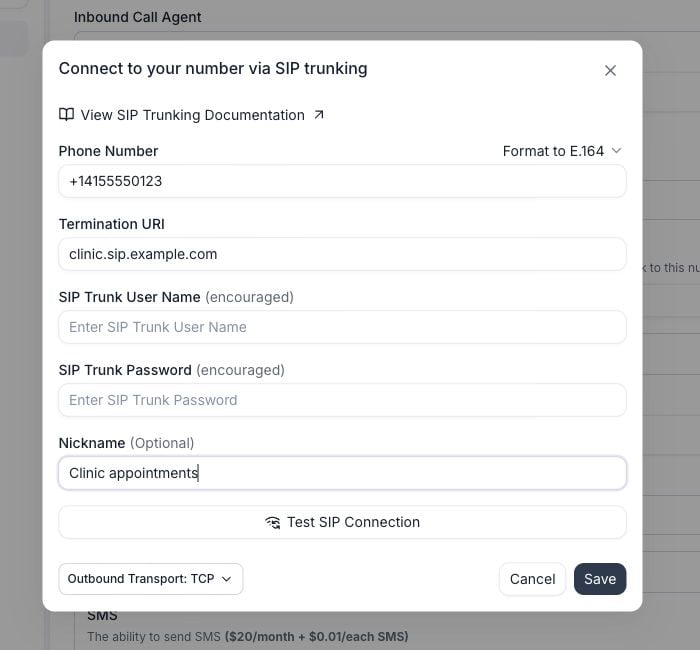
Test the SIP connection before saving your number's settings. Example values are shown.
What should I do if the connection test fails?
FAQ
Will it throw errors if the details or configuration is incorrect?
Will it throw errors if the details or configuration is incorrect?
My inbound call is not connecting, what should I do?
My inbound call is not connecting, what should I do?
My outbound call is not connecting, what should I do?
My outbound call is not connecting, what should I do?
Will I be able to transfer call using SIP trunking?
Will I be able to transfer call using SIP trunking?
Will I be able to press digit using SIP trunking?
Will I be able to press digit using SIP trunking?
Does Retell handle SIP re-INVITEs from my carrier or SBC?
Does Retell handle SIP re-INVITEs from my carrier or SBC?
Can I view and manage the numbers I import using SIP trunking?
Can I view and manage the numbers I import using SIP trunking?
I need to change the configuration of the imported number, how can I do that?
I need to change the configuration of the imported number, how can I do that?
Method 2: Dial to SIP URI
If your telephony provider does not support elastic SIP trunking, or you have a more complicated telephony setup that cannot use elastic SIP trunking, you can use this method. When using this method, Retell does not directly make or receive calls, but instead relies on your system to dial the call to the respective SIP URI. This would require you to have some code to handle integration with your telephony provider. All traffic looks like inbound to Retell in this case, so it’s up to you to specify the call direction. Here we assume you already have your call handling setup. For Retell to know what agent to use to handle the call, and for you to obtain SIP URI to use for this call, you would call the Register Phone Call API. You will get acall_id back from this API, and you would use it to piece
together the SIP URI.
sip:{call_id}@sip.retellai.comExample code
Here’s a simplified example that handles the inbound call webhook from Twilio and dials the call to the SIP URI.FAQ
How to transfer call/end call using dial to SIP method?
How to transfer call/end call using dial to SIP method?
Will I be able to press digit using dial to SIP method?
Will I be able to press digit using dial to SIP method?
Two entries created for a single dial?
Two entries created for a single dial?
Can I use telephony provider's other features like AMD detection using this method?
Can I use telephony provider's other features like AMD detection using this method?
Security center
Retell secures your voice communications. We recommend using TLS 1.2 or higher to secure all SIP signaling channels between your infrastructure and Retell’s SIP servers. To establish a secure TLS connection with Retell’s SIP server, you may need to add Retell’s server-side root CA to your trust store. You can download it here.Mutual TLS (mTLS)
Mutual TLS (mTLS) is an extension of the standard TLS protocol that provides two-way authentication between a client and a server. Unlike standard TLS — where only the server presents a certificate to prove its identity to the client — mTLS requires both sides to present and verify certificates. This ensures that only trusted, authenticated parties can establish a connection, significantly reducing the risk of man-in-the-middle attacks and unauthorized access. In a typical TLS handshake:- The server presents its certificate to the client.
- The client verifies the server’s certificate and the connection is established.
- The server presents its certificate to the client.
- The client also presents its certificate to the server.
- Both parties verify each other’s certificates before the connection is established.
Video tutorials
Elastic SIP trunking
Dial to SIP URI
Telephony partners
If you need to manipulate the SIP call flow or have custom needs Retell doesn’t directly support, check our telephony partners to see if they can help.- Jambonz: Jambonz is a SIP server that supports static IP address and can be used to connect to Retell’s SIP server to manipulate the SIP call flow. A dedicated Slack support channel is available for Retell users.
- Cloudonix: Cloudonix is a CPaaS that can be connected to Retell’s SIP server to manipulate the SIP call flow.