

Test LLM tab in your agent’s Test panel, and it has two modes: Manual Chat, where you type each turn yourself, and AI Simulated Chat, where an AI plays the user from a prompt.
For example, after adding a “reschedule appointment” path, open the Playground, ask to reschedule, and confirm the agent calls check_availability with the right date before you ever test it on a call.
Open the Playground
In the agent editor, open theTest panel and select the Test LLM tab. The panel’s other tab, Test Audio, is for live voice testing. The Test LLM tab isn’t available for custom LLM agents or speech-to-speech voice agents.
You can also open the same Playground from four other places. The first three each load an existing transcript into it with View In Test Playground:
- A call’s details panel in your Call History, or a conversation’s details panel in Chat History.
- A call’s details panel in AI QA.
- A run’s details panel in Batch Testing History.
- The
Test Subflowtab inside a Conversation Flow component, to test that component on its own.
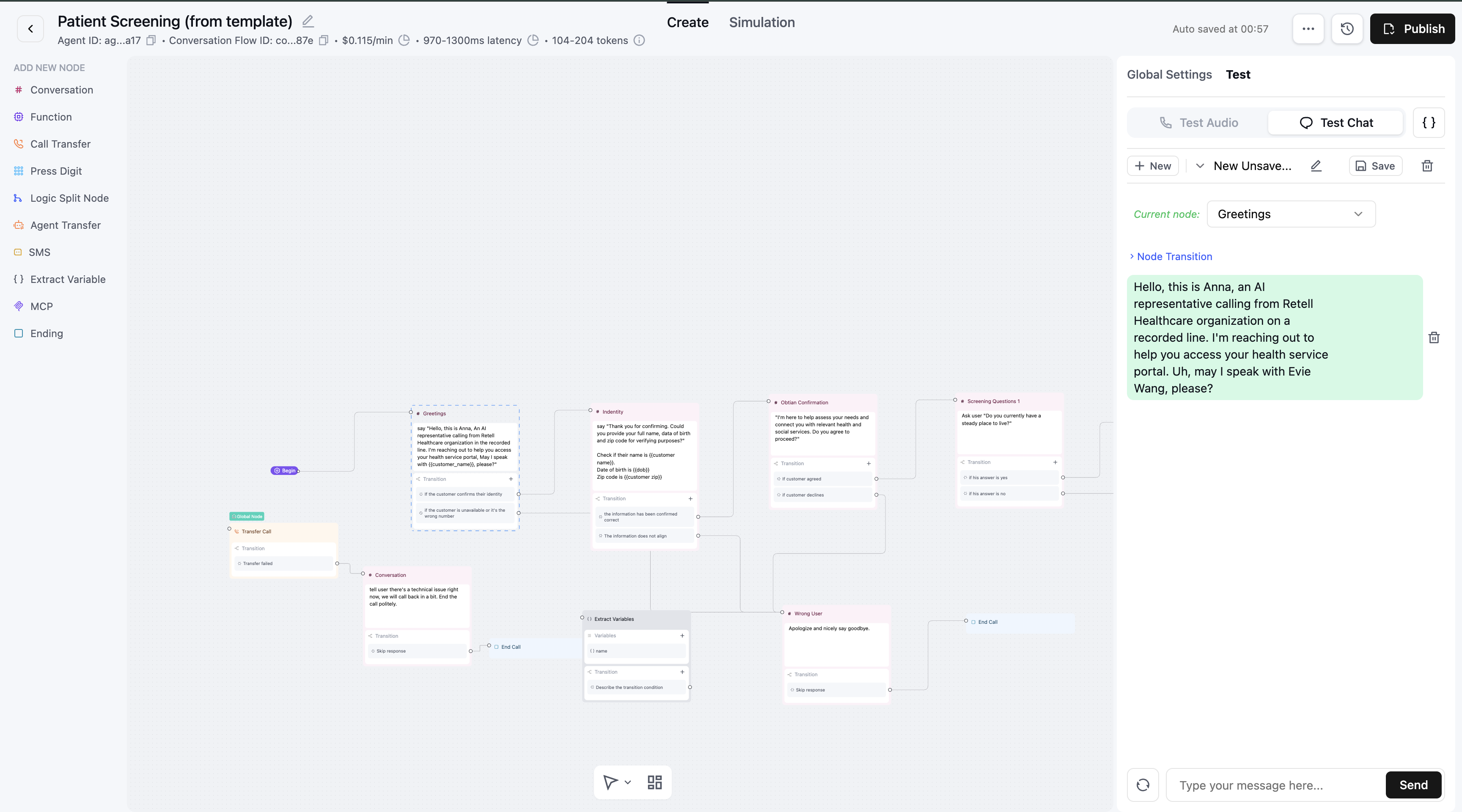
The LLM Playground on the Test LLM tab.
Chat with the agent manually
ChooseManual Chat to drive the conversation yourself. Type each turn the user would say and read the agent’s response. It doesn’t grade anything: it’s for exploring behavior turn by turn. Every turn shows the agent’s node transitions, tool invocations, and tool results inline, so you see what the agent did, not just what it said.
For a multi-prompt or Conversation Flow agent, the Current State or Current Node selector above the transcript sets where the conversation sits. Use it to start partway through the flow instead of at the beginning, and to jump the conversation elsewhere mid-chat, which saves talking your way to a branch you want to check.
New takes you back to the Manual Chat and AI Simulated Chat choice, where selecting Manual Chat again starts a fresh conversation. Save keeps the current conversation as a thread, and you rename it with the pencil next to the thread name. The trash icon appears once a thread is saved and deletes it. Use the dropdown on the thread name to switch between saved threads and compare runs.
Manual Test
Simulate a user
ChooseAI Simulated Chat to have an AI play the caller. It asks for two things: a user prompt (who the caller is and what they want) and the LLM setting (the model that plays the user). The run also picks up whatever dynamic variables and function mocks you’ve set in the Dynamic Variables dropdown, so set those first if the scenario needs them. Run it to watch the agent and the simulated user talk in real time, with node transitions, tool invocations, and tool results shown along the way.
A good user prompt spells out who the caller is, what they want, and how they behave:
Save. A dialog opens for you to add the test case’s success criteria, dynamic variables, and custom function mocks without leaving the page. The saved case then appears in the Simulation tab’s Test Cases list, ready to rerun or batch.
Running an AI Simulated Chat from a user prompt, with the agent and the simulated user talking turn by turn.
Test Playground
The Playground can change a conversation turn by turn. Open a transcript in it from Batch Testing History, your Call History, Chat History, or AI QA: open the details and clickView In Test Playground. The agent opens in a new tab with that transcript loaded into Manual Chat, which is the editable mode. From there you can:
- Edit a user turn. Confirming the edit truncates the conversation there and continues from your new wording.
- Rerun an agent response, which also drops the turns below it.
- Delete a single turn without touching the rest of the transcript.
- Replay the whole chat with the refresh button below the transcript, which clears the agent’s responses and resends every user turn in order against the current configuration.
- Type a new turn to carry the conversation on by hand.
A transcript loaded from history arrives as an ended conversation, so
Send is disabled at first. Edit a turn, delete one, or rerun an agent response and the input unlocks.Loading a transcript with View in Test Playground, then editing a turn and rerunning the flow from that point.
Set dynamic variables and mocks
Open theTest Inputs dropdown next to the tabs to set inputs before you chat, then click Save to apply them. It has two tabs:
Dynamic variables: give each dynamic variable a test value so placeholders resolve the way they would on a real call.Custom function mocks: set a pretend result for one of your agent’s functions. Your agent uses functions to do real things, like check availability, transfer a call, or send a text. A mock lets you tell the test what a function should return, so the agent reacts to that answer and the real action never runs.
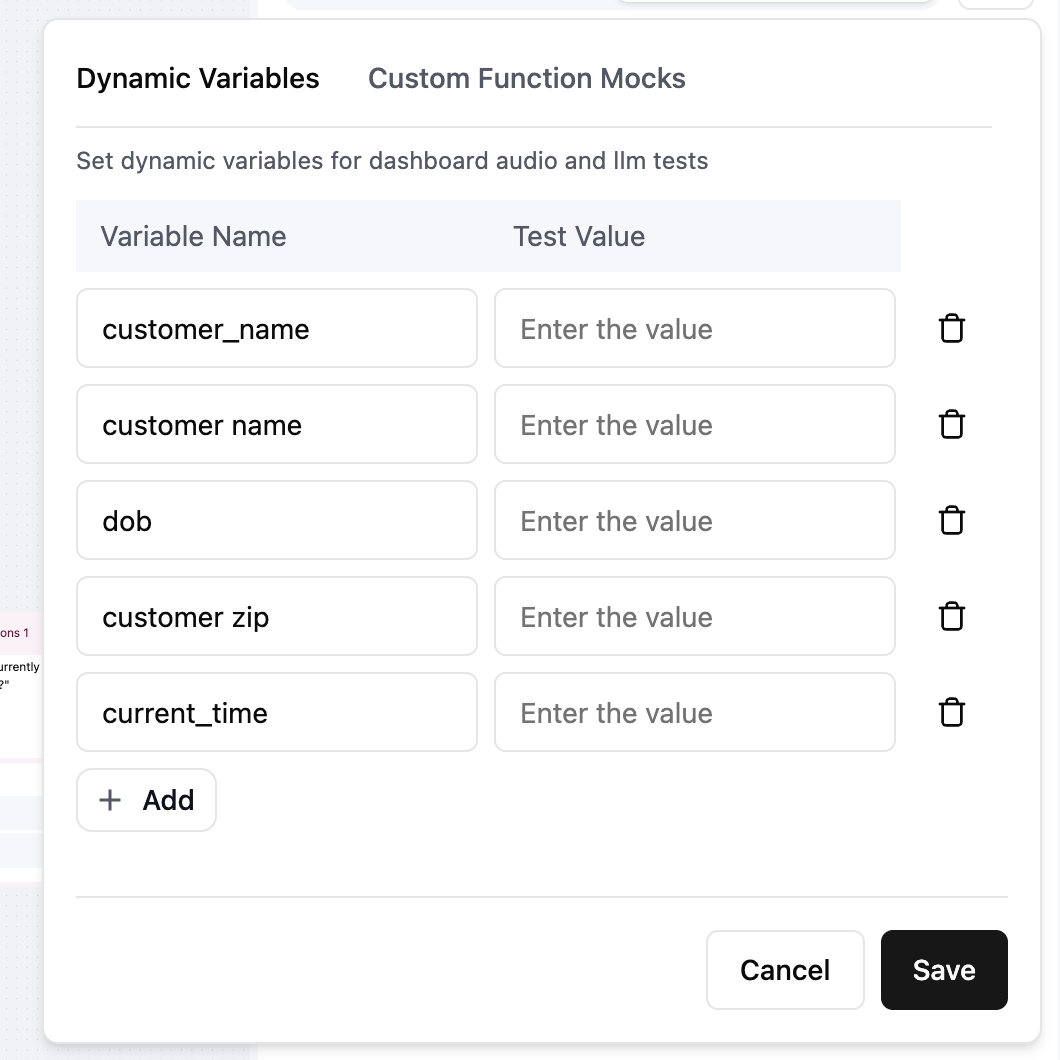
Setting dynamic variable test values.
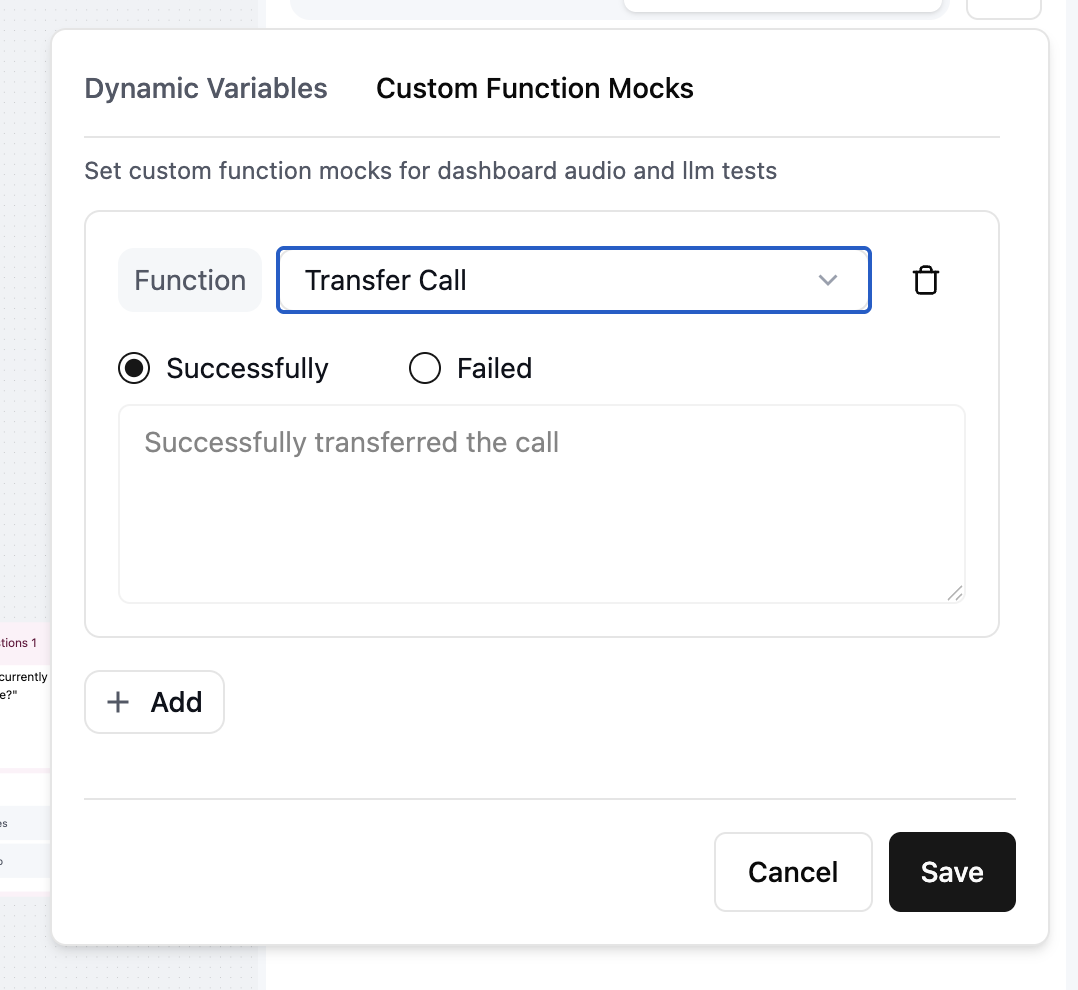
Mocking a custom function to return a set result.
Debug a response
When a reply looks off, click theDebug button on that turn. Debug can regenerate the answer 10 times and show a count of how often each response came up, so you can see the agent’s most common outputs on a non-deterministic turn. For the full fix workflow (finetune examples, node splits, temperature), see Debug your agent response.
Best practices
- Start simple, then work up to harder scenarios and edge cases.
- Mock the functions that take real action, like transferring a call or sending a text, so the test uses your pretend result and nothing actually happens.
- Use tool-call inspection to confirm parameters, not just the final wording.
- Save the threads worth revisiting, and turn the important ones into simulation test cases for regression testing.
Next steps
- Debug your agent response when a reply or transition is off.
- Simulation testing saves scenarios as graded, rerunnable test cases.
- Testing overview compares the Playground with simulation and live call testing.