

When to use MCP tools
Use an MCP server when the tools your agent needs already sit behind an MCP interface, or when you want to expose a set of tools to the agent through a single connection:- You already run an MCP server — reuse the same tools your other AI agents and IDE assistants call, without rebuilding them as custom functions.
- You want many tools from one integration — connect once, then pick which of the server’s tools the agent can access, instead of configuring each endpoint separately.
- You use a third-party MCP server — connect to a hosted MCP service (search, CRM, internal tooling) that already speaks the protocol.
This page is about connecting your agent to a remote MCP server so it can call that server’s tools. It’s not the same as Retell’s own MCP server, which lets MCP clients like Cursor and Claude Desktop manage your Retell account.
Example: order lookup over MCP
A retail support team already runs an MCP server that exposeslookup_order and create_ticket tools to its internal assistants. You connect a Retell support agent to the same server and enable both tools. When a caller gives an order number, the agent calls lookup_order and reads back the status; if the caller reports a problem, it calls create_ticket — with no separate custom function for either action.
How it works
You attach the MCP server to the agent, and each tool you enable becomes a tool the agent can call whenever your prompt and the tool’s description tell it to — the same way custom functions and prebuilt functions work. Retell connects to the server over Streamable HTTP, lists the server’s tools, and calls a tool with arguments the LLM fills in from the conversation. The tool’s response is handed back to the agent, which can speak it, act on it, or save parts of it as dynamic variables.Connect an MCP server
1
Add the MCP server
In your agent, open the MCPs section and click Add MCP.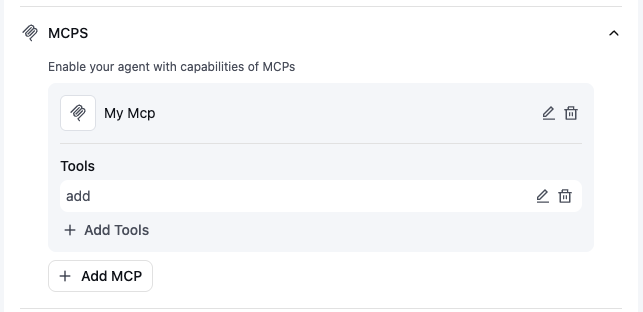
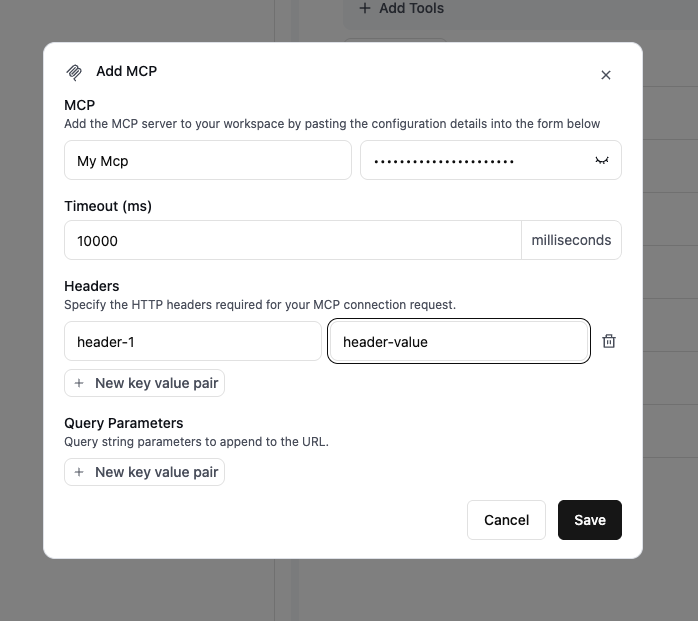
2
Set request headers (optional)
Under Headers, add the key/value pairs Retell sends with the MCP connection request — most often an auth header such as
Authorization: Bearer <token>. Click New key value pair for each header. Values can include dynamic variables, so you can pass a per-call token as {{api_key}}.3
Set query parameters (optional)
Under Query Parameters, add key/value pairs Retell appends to the server URL as a query string. Use this for servers that authenticate or route by query parameter. Values can include dynamic variables too.
4
Save the server
Click Save. The server appears in the MCPs section, ready for you to add tools.
5
Add a tool
On the saved server, click Add Tools. In Tool Access Scope, open the Select Tool dropdown and pick a tool — Retell connects to the server and lists its tools, each with its name and description.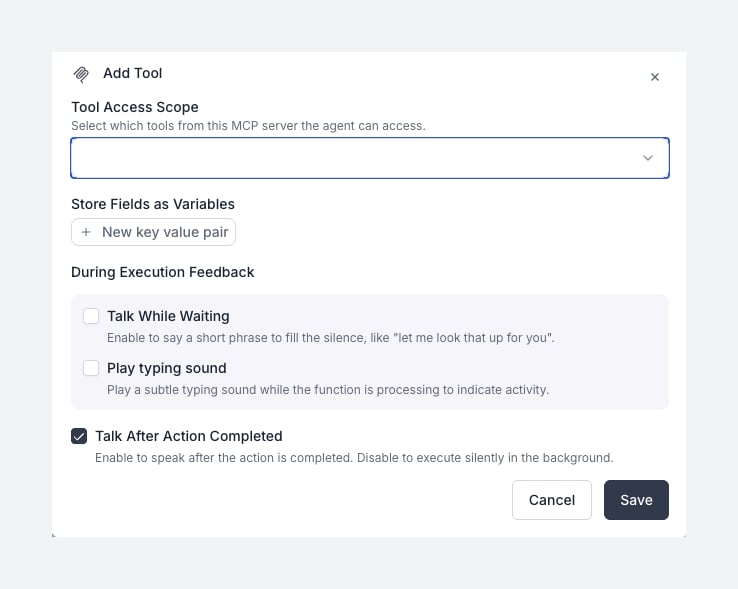
6
Set response variables (optional)
In Store Fields as Variables, extract values from the tool’s response and save them as dynamic variables to use later in the call. Each row maps a variable name to the path of a field in the response, using dot notation with array indexing where needed — for example
user.name or data.items[0].id. This works only when the tool returns a JSON object.For example, from this response you could save the name and reference it later as {{user_name}}:7
Configure speech behavior
Control what the agent does while the tool runs and after it returns:
- Talk While Waiting (off by default) — the agent says a short line to fill the silence while the tool runs, like “Let me look that up for you.” Choose Prompt to have the LLM generate the line, or Static Sentence to speak a fixed message you write. Turn it on for user-facing lookups; leave it off for background tasks. You can also enable Play typing sound to play a subtle typing sound while the tool runs.
- Talk After Action Completed (on by default) — the agent responds again once the tool returns, so it can read back the result or call another tool. Turn it off only for fire-and-forget tasks, like silently uploading a result to your server.
8
Save the tool
Click Save. The tool now appears under the server in the MCPs section.
9
Tell the agent when to call the tool
In your prompt, say explicitly when the agent should call each tool — the agent decides from the tool’s name, description, and your prompt. For example:
FAQ
What's the difference between an MCP tool and a custom function?
What's the difference between an MCP tool and a custom function?
Both let the agent take an action mid-call. A custom function calls one HTTP endpoint you host. An MCP tool connects to a remote MCP server that can expose many tools through a single connection, and Retell discovers those tools from the server. Use MCP when the tools already live behind an MCP server; use a custom function to call your own API directly.
Why isn't my agent calling the tool?
Why isn't my agent calling the tool?
The agent decides when to call a tool from its name, description, and your prompt. Add an explicit instruction in the prompt (for example, “When the user gives an order number, call
lookup_order”), and make sure the tool is added under the server in the MCPs section — only the tools you add there are available to the agent.How do I send a value from the tool response back into the conversation?
How do I send a value from the tool response back into the conversation?
Everything the tool returns is handed to the agent’s LLM, so the agent can speak or act on it right away. To reuse a specific field later in the call, map it to a dynamic variable under Store Fields as Variables and reference it as
{{variable_name}}.What transport does Retell use to reach my MCP server?
What transport does Retell use to reach my MCP server?
Retell connects over Streamable HTTP. The server URL must be publicly reachable over
http or https — Retell rejects any other protocol and blocks URLs that point to localhost, private network ranges, or cloud metadata endpoints. Pass any auth the server needs through the request headers or query parameters.My MCP server requires OAuth. Can Retell handle the OAuth flow?
My MCP server requires OAuth. Can Retell handle the OAuth flow?
No. Retell authenticates to your MCP server only through the request headers and query parameters you configure — it doesn’t run an interactive OAuth authorization flow. If your server requires OAuth, obtain the access token outside of Retell and pass it in a header such as
Authorization: Bearer <token>. For short-lived tokens, use a dynamic variable like {{access_token}} in the header value and pass a fresh token with each call.Can I restrict my MCP server to requests from Retell?
Can I restrict my MCP server to requests from Retell?
Yes. Retell’s outbound requests come from the IP address
100.20.5.228, the same address used for custom functions and webhooks. Allowlist it at your firewall, and add a secret in the request headers or query parameters as a second check.Can I use dynamic variables in the MCP server URL?
Can I use dynamic variables in the MCP server URL?
Yes. The URL accepts dynamic variables the same way headers and query parameters do — for example
https://mcp.example.com/{{tenant_id}}. Retell fills them in when it connects. Every variable in the URL must resolve at call time; if one is still unset, the connection fails with an error instead of calling an incomplete URL.Does Retell retry a failed tool call?
Does Retell retry a failed tool call?
No. If a tool call fails or times out, the agent receives the error and continues based on your prompt. Keep your server responsive, and make side-effecting tools like creating a ticket idempotent so a repeat call is safe.
Is there a limit on the tool response?
Is there a limit on the tool response?
Yes. Retell uses the tool’s text response and caps it at 15,000 characters by default before handing it to the LLM, so return only what the agent needs. Contact support if you need a higher limit.
Can I use MCP tools in a conversation flow agent instead?
Can I use MCP tools in a conversation flow agent instead?
Yes. Conversation flow agents call MCP tools through a dedicated MCP node rather than adding them to the response engine. The server configuration (URL, headers, query params) is the same; the difference is where the tool call fits in the flow.