

Add a function
Here you need to add the function first, and then select it inside the node. This way if you delete the node, you don’t need to re-create the function again.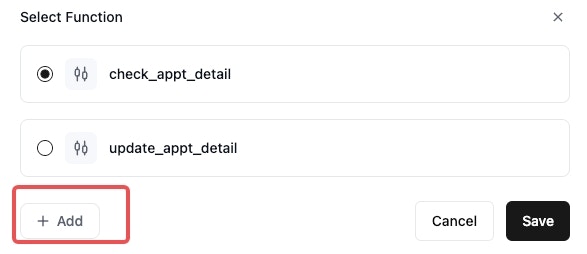
- Custom Function
- Integration tools from connected providers like HubSpot, Salesforce, Zendesk, and Cal.com
To check availability or book appointments, use the Cal.com or Calendly integration tools. The built-in Cal.com functions are no longer offered in the node — see the deprecation notice for what happens to flows that still have them.
Choose an execution mode
Under Function settings → Execution mode, choose how the flow handles the tool result:
With Wait for completion, you can configure Talk While Waiting with a prompt or static sentence, or enable Play typing sound. These feedback controls are hidden in background mode. If a waiting message is still being spoken when the result arrives, the transition also waits for that speech to finish. Caller interruptions can affect the speech timing.
The API still uses the node’s
wait_for_result boolean: true waits, and false runs in the background. A custom function’s execution status variable can distinguish execution success from failure before you route the conversation.
Node settings
Select the node to open the Node settings tab. Function settings contains the function selector and execution controls; the separate Node settings section contains general node options. Both sections can stay open together.- Execution mode: choose Wait for completion or Run in background (async) under Function settings, as described above.
- Global Node: read more at Global Node
- LLM: choose a different model for this particular node. Will be used for function argument generation, and potentially speak during execution message generation.
- Fine-tuning Examples: Can finetune transition. Read more at Finetune Examples